- Real name: Unknown
- Name used: Dan Cooper
- Known to history as: D.B. Cooper
- Date of disappearance: 24 November 1971
- Ransom: $200,000
- Body recovered: No
- Fate: Unknown
The man who disappeared without needing to fake his death.
The Man at Portland Airport
On the afternoon of 24 November 1971, a man walked into Portland International Airport and approached the Northwest Orient Airlines counter.
There was little about him that should have attracted attention. He appeared to be in his mid-forties and was dressed like thousands of businessmen who passed through American airports every day. He wore a dark business suit, a white shirt and a black tie. In his hand was an attaché case.
He paid cash for a one-way ticket on Northwest Orient Flight 305, a short flight from Portland to Seattle.
When the airline employee asked for his name, he gave it without hesitation.
Dan Cooper.
It wasn't until later that a reporting mistake would transform him into D.B. Cooper, the name by which the world would remember him. The FBI has never discovered his real name.
Cooper boarded the Boeing 727 and took his seat towards the back of the aircraft. There were 36 passengers aboard. Nothing about the man in the suit suggested that this particular flight was going to be remembered more than half a century later.
He ordered a bourbon and soda.
Then, shortly after three o'clock, he handed a note to a flight attendant.
At first, she didn't read it.
Cooper leaned towards her.
She might want to look at the note, he told her.
He had a bomb.
The Briefcase
The flight attendant sat beside him.
Cooper opened his attaché case just far enough for her to see inside. There appeared to be several red cylinders surrounded by wires.
Whether the bomb was genuine has never been established.
At that moment, it didn't particularly matter.
Cooper calmly explained what he wanted.
He demanded $200,000 in twenty-dollar bills and four parachutes. If those demands were met when the aircraft reached Seattle, he would release the passengers.
There was no shouting and no dramatic confrontation. Contemporary descriptions repeatedly portrayed Cooper as calm and controlled. While the passengers around him continued their journey, most had no idea that the ordinary-looking businessman sitting near the back of the aircraft had just hijacked their plane.
The pilots contacted the authorities.
Flight 305 remained in the air while the money and parachutes were gathered below.
Cooper waited.
Four Parachutes
The demand for four parachutes would later become one of the cleverest details of the hijacking.
Cooper only needed one to escape, so why ask for four?
One explanation is that he wanted the authorities to believe he intended to take hostages with him. If the FBI or airline supplied a deliberately defective parachute, they couldn't know whether Cooper or an innocent crew member would end up wearing it.
There is no way of knowing whether that was genuinely Cooper's thinking. He never explained it.
But the authorities complied.
When Flight 305 finally landed at Seattle, the ransom money and parachutes were delivered to the aircraft.
Cooper then did exactly what he had promised.
He released the passengers.
Thirty-six people walked away from the aircraft unharmed.
Cooper remained aboard with members of the crew.
He still had the apparent bomb.
He now had four parachutes.
And he had $200,000.
But the strangest part of his plan hadn't even begun.
Back Into the Air
Cooper wanted the Boeing 727 flown towards Mexico City.
His instructions were unusual. He wanted the aircraft kept low, at around 10,000 feet, and travelling relatively slowly. Most importantly, he wanted access to the Boeing's rear staircase.
The 727 had a set of stairs beneath its tail that could be lowered from inside the aircraft.
For Cooper, they provided something extremely valuable.
A way to leave an aircraft while it was still flying.
The Boeing took off from Seattle and headed south. Outside, darkness had settled over the Pacific Northwest. The weather was poor and rain was falling.
Cooper stayed at the back.
Eventually, he told flight attendant Tina Mucklow to go forward and join the rest of the crew.
For the first time since the hijacking began, Cooper was alone.
Nobody knows exactly what he did during the next few minutes.
He had the ransom.
He had the parachutes.
And somewhere below him was the darkness of south-western Washington.
The Jump
A little after eight o'clock that evening, the crew noticed a change in the aircraft.
There was a movement from the rear of the Boeing consistent with the staircase being lowered and someone leaving the aircraft.
Nobody actually watched Cooper jump.
There was no witness standing at the open door.
There was no second parachutist following him.
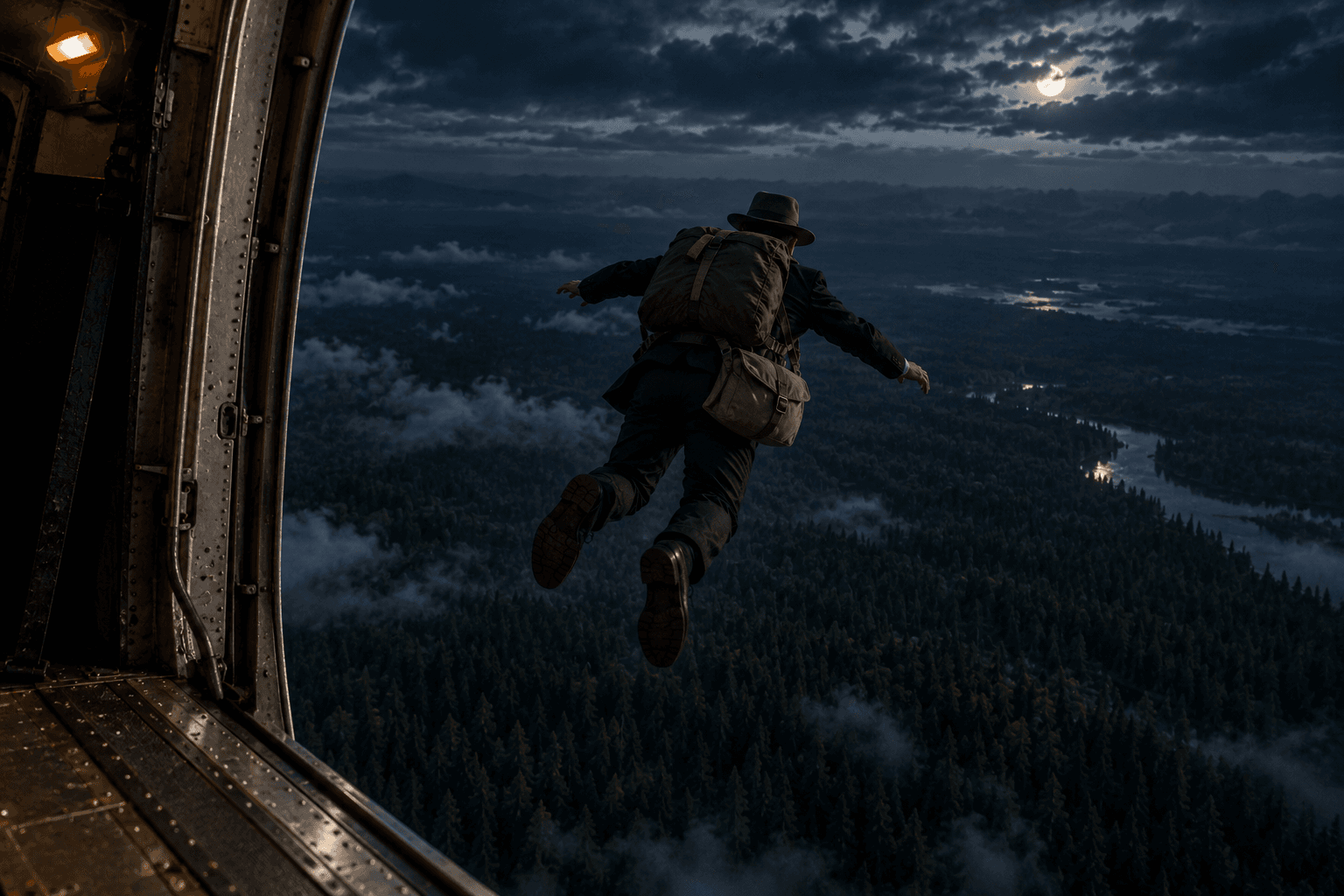
Somewhere between Seattle and Reno, the man calling himself Dan Cooper appears to have strapped on a parachute, taken the ransom money and stepped from the back of Flight 305 into the night.
The aircraft continued south.
When it eventually landed at Reno, FBI agents boarded and searched it.
Cooper was gone.
The ransom was gone.
One of the most extraordinary manhunts in American history was about to begin.
But investigators immediately faced a problem.
They didn't know exactly where to look.
Somewhere in the Darkness
The crew could tell investigators approximately when they believed Cooper had jumped, but they couldn't provide a precise location.
The aircraft had been moving through darkness and poor weather. Calculations using its flight path, speed and the change experienced when the rear stairs were lowered gave investigators a likely area in south-western Washington.
Search teams went looking for him.
Aircraft searched from above. Men searched forests and difficult terrain on the ground.
They were looking for anything that could tell them what had happened after Cooper left the aircraft.
A parachute caught in a tree.
The ransom bag.
Clothing.
A body.
They found none of them.
As the days became weeks and the weeks became months, the obvious explanation was that Cooper had attempted an escape he simply wasn't equipped to survive.
The FBI itself would eventually say it considered it likely that he had died during or shortly after the jump. The parachute he chose couldn't be steered, his clothing and shoes were poorly suited to a rough landing, and he had jumped at night into difficult country in bad weather.
It was a convincing explanation.
Except there was no D.B. Cooper.
If He Died, Where Was He?
A missing body in the wilderness is hardly impossible.
Cooper may have landed in dense forest. He could have been badly injured on impact and died somewhere search teams never reached. His parachute might have been concealed by vegetation, and years of weather could eventually have destroyed much of the evidence.
There is nothing particularly mysterious about that possibility.
But as the years passed, the absence of physical evidence became increasingly difficult to ignore.
No confirmed remains appeared.
No confirmed parachute was recovered.
Nobody discovered the ransom bag hanging from a tree or lying beside a skeleton.
If Cooper had died that night, the landscape had hidden him remarkably well.
If he had survived, however, he had achieved something even more impressive.
He had walked away from one of the biggest FBI manhunts in America.
The Man They Were Looking For Didn't Exist
Investigators faced another problem that made Cooper particularly difficult to find.
They didn't know who they were looking for.
There was no passport identifying him.
No home address.
No known family.
No employment record connected to the name on his ticket.
The FBI had descriptions supplied by people aboard the aircraft and produced composite sketches from them. But there was no photograph of the hijacker.
Even the name everybody knew him by was wrong.
The man had called himself Dan Cooper, not D.B. Cooper. The initials became attached to the case after the press confused him with another man investigators had briefly considered.
It meant Cooper had accidentally gained another layer of protection.
Police weren't merely searching for a missing criminal.
They were searching for a man whose identity may have existed for only a few hours.
Then, Nine Years Later, Something Appeared
For almost a decade, Cooper seemed to have vanished completely.
Then in February 1980, eight-year-old Brian Ingram was with his family beside the Columbia River at a place known as Tina Bar.
While digging in the sand, he uncovered something strange.
Money.
Not a few loose notes. There were deteriorating bundles of twenty-dollar bills buried in the riverbank.
The FBI checked the serial numbers.
They matched the ransom given to Cooper.
Approximately $5,800 had finally resurfaced.
It was the first significant physical evidence from Cooper's escape to appear since the hijacking.
It should have helped solve the mystery.
Instead, it created another one.
How had the money reached the Columbia River?
The Money That Shouldn't Have Been There
Investigators knew the serial numbers of every note given to Cooper.
That should have made the ransom dangerous to spend.
Yet the money didn't begin appearing in banks or shops after the hijacking. There was no trail of twenty-dollar bills leading investigators towards a new house, a car or a suddenly wealthy suspect.
Then some of it appeared beside a river nine years later.
Perhaps Cooper had lost the ransom during the jump.
Perhaps the bag had fallen into water and part of its contents eventually travelled downstream.
Perhaps Cooper survived and deliberately buried some of it.
Perhaps somebody else moved it.
Each explanation created another question.
If the ransom was lost, why had only $5,800 been found?
If Cooper survived, what happened to the rest?
And if he died with the money, where was the body?
The discovery at Tina Bar proved that at least part of Cooper's ransom had eventually reached the Columbia River.
It did not explain how.
The One Thing Cooper Left Behind
Cooper had disappeared, but he hadn't left the aircraft completely empty-handed.
Among the items recovered was the black clip-on tie he had been wearing earlier in the flight. FBI agents searching the Boeing in Reno recorded finding it on a seat near where the hijacker had been sitting.
At the time, it was simply another piece of physical evidence.
Decades later, advances in forensic science gave the tie new importance when investigators attempted to obtain DNA evidence from material associated with the case.
For a moment, it offered the possibility that the anonymous passenger might finally have left behind something capable of revealing his identity.
But there was a problem.
A tie can carry biological material from more than one person, particularly an item that has been manufactured, sold and handled before being worn. Without a confirmed sample known to have come from Cooper, DNA couldn't simply produce his name.
New forensic techniques helped investigators test suspects.
They did not tell them who Cooper was.
The Suspects
Over the decades, hundreds of names entered the investigation.
Some suspects had aviation experience. Others were parachutists or military veterans. Some resembled the FBI sketches. Families came forward convinced that a dead father, husband, uncle or brother had been the mysterious hijacker.
There were alleged confessions.
Stories of unexplained money.
Photographs that seemed to resemble the sketch.
People who had behaved strangely around Thanksgiving 1971.
Some suspects appeared compelling until investigators examined them closely.
One man stood out because what he did afterwards was almost unbelievably similar.
His name was Richard Floyd McCoy Jr.
Less than five months after Cooper disappeared, McCoy hijacked another Boeing 727, demanded money and parachutes, and escaped from the aircraft by jumping.
This time, however, the hijacker didn't disappear forever.
McCoy was caught.
The similarities inevitably led people to wonder whether the FBI had finally found Cooper.
Investigators didn't believe so. Among the problems was the fact that McCoy did not match the descriptions independently provided by the flight attendants who had spent time close to Cooper.
McCoy therefore became another fascinating possibility rather than an answer.
And the list of suspects kept growing.
How Much Did Cooper Really Know?
The hijacking gives the impression of a man who had thought carefully about what he was doing.
Cooper chose a Boeing 727 and understood the usefulness of its rear staircase. He knew enough about the aircraft to give instructions concerning its flight configuration, speed and altitude. He understood that he could potentially leave the aircraft from the rear while it was flying.
Yet other details make him seem less like an expert.
The parachute he selected couldn't be steered. His clothing was unsuitable for the conditions waiting below. He jumped at night, in poor weather, without being able to know his exact position over the ground.
That contradiction has fascinated investigators ever since.
Perhaps Cooper was highly experienced and deliberately concealed what he knew.
Perhaps he had military or aviation experience but wasn't an expert parachutist.
Or perhaps he was simply a clever man who knew enough about aircraft to design a plan that was considerably more dangerous than he realised.
There is no proven answer.
Did Cooper Survive?
The simplest explanation remains that he didn't.
He jumped from a Boeing 727 at night into bad weather carrying a heavy bag of money. He was dressed like a businessman rather than someone preparing to spend the night in the wilderness. The parachute he chose offered limited control, and investigators never found evidence that he later spent the ransom.
The FBI itself considered his chances of surviving poor.
But this is what makes Cooper different from almost every other Utopia File.
There is no death certificate to challenge.
No autopsy to explain.
No body that must secretly belong to somebody else.
No coffin.
No grave.
There is simply a man stepping from an aircraft and disappearing.
If Cooper landed safely, hid the parachute, reached a road and eventually returned to an ordinary life under his real name, the historical evidence might look almost exactly as it does today.
That doesn't mean he survived.
It means nobody has ever proved that he didn't.
The Perfect Disappearance
Perhaps Cooper's greatest advantage was that he never needed to become a fugitive called D.B. Cooper.
That man didn't exist.
Imagine for a moment that he survived the jump.
He reaches the ground battered, cold and exhausted. Perhaps the ransom is damaged or partly lost. He hides the parachute and starts walking.
Eventually he reaches civilisation.
He doesn't need a false passport.
He doesn't need plastic surgery.
He doesn't need to create a new identity.
He simply goes back to the identity he already had.
The police are searching for a drawing.
They have an approximate age and height.
They know what clothes he wore.
They know the false name on his airline ticket.
But they don't know where he lives.
They don't know where he works.
They don't know whether he has a wife waiting at home.
They don't even know what his real name is.
The following Monday, D.B. Cooper could theoretically have gone back to work.
And nobody sitting beside him would necessarily have known.
Forty-Five Years
The FBI called its investigation NORJAK, short for Northwest Hijacking.
Agents followed leads across America. Witnesses were interviewed. Suspects were examined. Evidence was repeatedly reconsidered as forensic technology improved.
The investigation lasted forty-five years.
Eventually, in July 2016, the FBI announced that it was redirecting the resources assigned to NORJAK towards other priorities.
It wasn't announcing that Cooper had been identified.
Quite the opposite.
After decades of investigation, thousands of tips and numerous suspects, the Bureau still couldn't establish who had hijacked Flight 305. It preserved the evidence and said it would still want to hear about significant physical evidence relating specifically to the parachutes or ransom money.
The FBI had stopped actively hunting D.B. Cooper.
The mystery hadn't been solved.
The Questions That Remain
More than half a century later, almost everything after the moment Cooper stepped from the aircraft remains uncertain.
Who was the man who called himself Dan Cooper, and why did he choose that particular flight? Had he studied the Boeing 727 because of its rear staircase, or did his knowledge come from working around aircraft? Was he a former serviceman, a pilot, an engineer, or simply someone who had done enough research to believe his plan would work?
Most importantly, what happened when he jumped?
If Cooper died in the wilderness, why have no confirmed remains or parachute ever been recovered? If the ransom disappeared with him, how did some of it reach Tina Bar? And if he survived, why did almost none of the money ever appear in circulation?
Perhaps he lost most of it.
Perhaps he was frightened to spend it.
Perhaps the money mattered less than proving he could do it.
Or perhaps the answer is much simpler and still waiting somewhere in the history of an apparently ordinary man who returned home after Thanksgiving 1971 and never told anybody what he had done.
There is one question that no investigation has ever been able to answer.
When D.B. Cooper disappeared into the darkness that night, was it the end of his life, or simply the end of Dan Cooper?