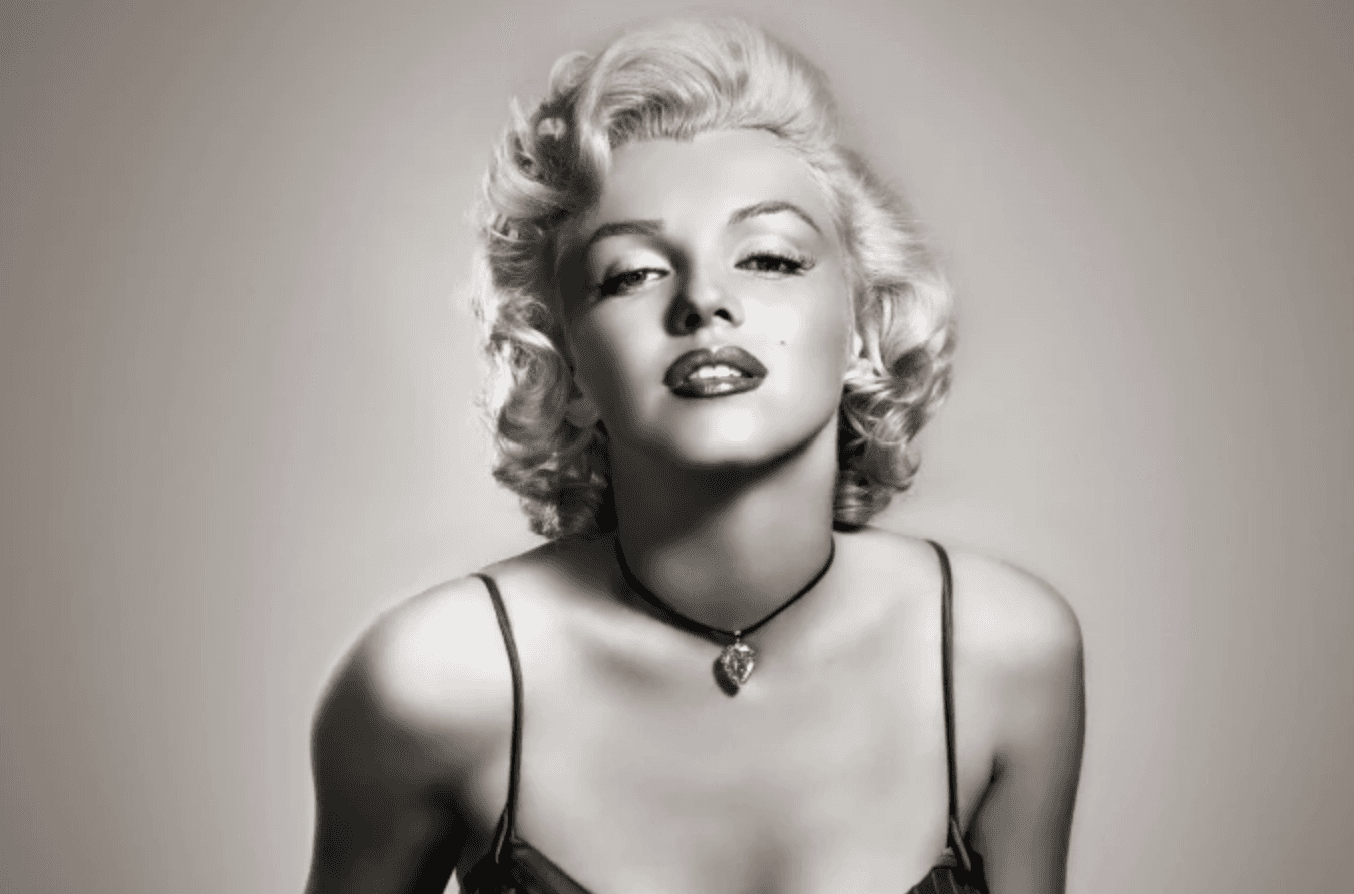
- Born: 1 June 1926
- Officially died: 5 August 1962
- Age: 36
- Location: Brentwood, Los Angeles
- Official cause: Acute barbiturate poisoning
- Official manner of death: Probable suicide
- Autopsy: Yes
- Status: Officially deceased
Did Marilyn Monroe really take her own life?
Marilyn
By 1962, Marilyn Monroe was one of the most recognisable women in the world.
She had gone from a difficult childhood and years spent in foster care to becoming perhaps Hollywood's greatest female star. Films such as Gentlemen Prefer Blondes, The Seven Year Itch and Some Like It Hot had transformed her into an international icon.
But the public image concealed a much more troubled private life.
Her marriages had failed. Her relationship with Hollywood studios had become increasingly difficult. She struggled with insomnia and her use of prescription medication had become a serious problem. She was receiving psychiatric treatment and, during the final months of her life, people around her were concerned about her emotional state.
Yet this wasn't simply the story of a woman disappearing from public life.
Marilyn was still Marilyn.
She remained famous.
She was making plans.
She was talking to friends.
And she had connections to some extraordinarily powerful people.
Then, during the early hours of 5 August 1962, she was found dead in the bedroom of her Brentwood home.
She was thirty-six.
The official conclusion was suicide.
Almost immediately, people began asking whether that was really what had happened.
The Final Night
Marilyn spent Saturday 4 August 1962 at her home at 12305 Fifth Helena Drive in Brentwood.
Her housekeeper, Eunice Murray, was staying at the property.
Marilyn was also in regular contact with her psychiatrist, Dr Ralph Greenson, and her physician, Dr Hyman Engelberg.
According to contemporary police information, Monroe spoke to Greenson during the evening and complained that she could not sleep. He later said he advised her to go for a drive.
What happened during the following hours has been argued over ever since.
According to Murray's account, she woke during the night and noticed that the light beneath Marilyn's bedroom door was still on.
The bedroom door was locked.
Murray could not get a response.
She looked through a window and saw Marilyn lying on the bed.
She then contacted Greenson.
Greenson arrived at the house at around 3.40 am.
Unable to enter through the locked door, he broke a bedroom window and climbed inside.
Marilyn was lying naked on the bed.
A telephone was beside her.
Greenson believed she was dead.
Dr Engelberg was called and subsequently pronounced Marilyn dead at approximately 3.50 am.
Police were not called until around 4.20 am.
That gap between discovering the body and notifying police would later become one of the details repeatedly examined by conspiracy researchers.
The Bedroom
When police entered Marilyn's home, they found numerous medicine containers near her bed.
A bottle that had contained the barbiturate Nembutal was empty.
Dr Engelberg later confirmed that he had prescribed Nembutal to Marilyn only a few days before her death, with instructions that she take one capsule at night to help her sleep. The bottle had originally contained fifty capsules.
The scene therefore offered an apparently straightforward explanation.
A woman known to suffer from insomnia and emotional difficulties.
An empty bottle of strong sedatives.
A body.
No obvious signs of violence.
But the autopsy would introduce details that kept the argument alive.
The Autopsy
An autopsy was carried out by deputy medical examiner Dr Thomas Noguchi.
Toxicological testing found a lethal concentration of barbiturates in Marilyn's body.
The eventual official conclusion was acute barbiturate poisoning, with the manner of death classified as probable suicide.
Los Angeles County Chief Medical Examiner Theodore Curphey publicly announced on 17 August 1962 that Marilyn's death had been caused by a self-administered overdose of sedative drugs and that the probable manner of death was suicide.
That remains the official conclusion.
But even the wording is worth noticing.
Not simply:
Suicide.
The official classification was:
Probable suicide.
That reflected the fact that investigators could establish how Marilyn died medically, but could not know with absolute certainty what her intention had been when she took the medication.
Was It Possibly an Accident?
Yes.
This is important because the real alternative to suicide does not automatically have to be murder.
Marilyn had access to several prescription medicines.
She suffered from severe insomnia.
She had doctors prescribing medication.
And combining sedative drugs can be extremely dangerous.
When the Los Angeles County District Attorney's office re-examined the case in 1982, investigators concluded that the available evidence was consistent either with suicide or an accidental overdose.
So there are at least three broad possibilities that have been argued over ever since:
Suicide.
Accidental overdose.
Murder.
Only the first was adopted as the official probable conclusion.
The Investigation Wasn't Perfect
This is one of the strongest legitimate reasons questions survived.
The original investigation has been criticised for the handling of the scene and evidence.
Later reporting based on the 1982 review described delays in securing the house and the disappearance or destruction of some tissue samples taken during the autopsy.
There was also no formal public inquest.
Instead, Curphey assembled a small team of mental-health professionals to conduct what would now be described as a psychological autopsy.
Their investigation lasted only eleven days.
Some potentially significant people were not formally interviewed at the time, and the interviews that were conducted were not given under oath.
That doesn't prove a cover-up.
But it left weaknesses in the record.
And those weaknesses became increasingly important once rumours about Marilyn's relationships began circulating.
The Kennedys
No part of the Marilyn Monroe conspiracy has generated more attention than her alleged relationships with President John F. Kennedy and his brother, Attorney General Robert F. Kennedy.
Marilyn famously sang 'Happy Birthday' to President Kennedy at Madison Square Garden in May 1962.
Rumours that she had been romantically involved with JFK had already circulated.
Claims involving Robert Kennedy followed.
The problem is separating documented contact from decades of increasingly elaborate allegations.
The FBI's own Monroe files show that the Bureau collected information about her contacts, political views and her presence at social gatherings involving President Kennedy. One FBI document records informants reporting that Marilyn attended a luncheon at Peter Lawford's residence with Kennedy.
That establishes that Marilyn moved within circles connected to the Kennedys.
It does not establish that either Kennedy murdered her.
What Did Marilyn Know?
This is where the conspiracy develops.
Some theories claim Marilyn knew sensitive information because of her alleged relationships with powerful political figures.
Others claim she had kept a diary in which she recorded conversations or secrets.
Some versions go much further, suggesting intelligence agencies, organised crime or senior political figures feared she might talk publicly.
The supposed missing diary became important enough that concerns about it helped trigger calls for a fresh investigation decades later. The Los Angeles County District Attorney's 1982 review was partly prompted by allegations that such a diary had disappeared from the coroner's office.
But there is a major problem.
No authenticated diary containing explosive Kennedy or national-security secrets has ever emerged.
So although the claim of a missing diary is part of the historical controversy, the extraordinary contents sometimes attributed to it are not proven facts.
Was Robert Kennedy at Marilyn's House?
This is one of the most repeated claims in the entire story.
Years after Marilyn's death, Eunice Murray made statements suggesting that Robert Kennedy had visited Marilyn on the night she died and that an argument took place.
But Murray's accounts changed over time.
HISTORY notes both the claim and the doubts surrounding its reliability.
There is no established contemporary evidence proving that Robert Kennedy was inside Marilyn's house during the critical period when she died.
That doesn't mean every claim is impossible.
It means it cannot responsibly be presented as fact.
For the Utopia Files, that distinction matters.
Robert Kennedy being in Los Angeles around that period is one thing. Robert Kennedy being inside Marilyn Monroe's house and participating in her death is an allegation, not an established historical fact.
The Time of Death
Another area of disagreement concerns exactly when Marilyn died.
The contemporary Los Angeles Times reported that she had been dead for an estimated six to eight hours when her body was discovered.
If accurate, that would place her death considerably earlier than the time police were summoned.
Over subsequent decades, alternative timelines appeared, some claiming Marilyn had died much earlier and that people at the house spent hours arranging the scene before contacting authorities.
Those allegations became part of later conspiracy theories.
But they are not conclusively established.
Post-mortem estimates of time of death are rarely precise enough to construct an exact minute-by-minute timeline, particularly using forensic techniques available in 1962.
So this remains an uncertainty rather than proof of criminal activity.
The Phone
Marilyn was found near a telephone.
That has become another haunting element of the story.
Some accounts describe the receiver being in or near her hand.
Contemporary reporting stated that she was found clutching the telephone receiver.
Who had she spoken to last?
Peter Lawford, brother-in-law to President Kennedy, was among the people known to have spoken with Marilyn that evening.
He later described becoming concerned during a telephone call because Marilyn sounded heavily sedated.
Yet Lawford was not formally interviewed by LAPD about that conversation until many years later.
Again, the significance lies less in proving a conspiracy than in demonstrating how incomplete parts of the original investigation were.
John Miner
One of the people who later rejected the suicide conclusion was John Miner, a Los Angeles County deputy district attorney who had been involved in the original investigation.
Miner eventually claimed he had listened to tapes Marilyn had recorded for Dr Greenson shortly before her death.
He said the recordings showed a woman making plans for her future rather than preparing to kill herself.
But there is a serious evidential problem.
The original tapes no longer exist.
Miner was the principal source for what they supposedly contained.
Greenson had died by the time Miner publicly gave detailed accounts of them, and Miner believed Greenson had destroyed the tapes.
That makes Miner's account interesting.
It does not make it independently verifiable.
And even if Marilyn was making future plans, that alone would not conclusively rule out suicide.
The 1982 Investigation
By the early 1980s, the conspiracy surrounding Marilyn's death had become so persistent that Los Angeles County District Attorney John Van de Kamp ordered the case reviewed.
The inquiry lasted approximately three and a half months.
Investigators examined documents and interviewed witnesses to determine whether there was sufficient evidence to justify opening a homicide investigation.
Their conclusion was clear.
They found no credible evidence supporting a murder theory.
They also concluded that there was reasonable evidence supporting the original finding that Marilyn had died from a self-administered barbiturate overdose, whether deliberate or accidental.
That investigation is extremely important because it was conducted specifically to examine the claims of foul play.
It did not find evidence sufficient to support them.
So Why Does the Murder Theory Survive?
Because the surrounding story is almost impossible to separate from the people involved.
Marilyn Monroe wasn't simply a Hollywood actress.
She was connected socially to some of the most powerful people in America.
The president.
The attorney general.
People in Hollywood.
People connected to organised crime.
People being monitored by the FBI.
The FBI files released publicly show that the Bureau really did gather information about Marilyn, particularly concerning her political associations and contacts.
That fact can sound sinister when removed from context.
But FBI interest in Marilyn is not proof that the FBI killed her.
The real history provides enough unusual details without needing to manufacture additional ones.
Was Marilyn Silenced?
For the murder theory to work, someone must have had a reason to kill her.
The usual argument is that Marilyn knew too much.
Perhaps about JFK.
Perhaps about Robert Kennedy.
Perhaps about government affairs discussed casually around her.
Perhaps about organised crime.
And perhaps she was becoming unstable enough that powerful people feared she would reveal what she knew.
It makes an extraordinary story.
But the historical evidence supporting that chain of events is weak.
There is no authenticated document showing that Marilyn threatened to expose national secrets.
There is no proven recording of Kennedy officials ordering anything to happen to her.
There is no established forensic evidence demonstrating that another person administered the fatal drugs.
There is no credible evidence identified by the 1982 review showing that Marilyn was murdered.
That doesn't erase the inconsistencies.
It places them in context.
The Strongest Evidence Against the Conspiracy
Marilyn had a documented history of emotional difficulties and insomnia.
She was under psychiatric care.
Her doctor had recently prescribed a powerful barbiturate.
An empty bottle was found near her bed.
Toxicology testing found fatal levels of barbiturates.
An autopsy was performed.
There was no obvious evidence of physical violence.
The coroner concluded the drugs had been self-administered.
A psychological investigation concluded her death was probably suicide.
And a separate District Attorney's review twenty years later found no credible evidence supporting murder.
That is substantial evidence.
Any theory claiming Marilyn was murdered has to confront it.
But Some Questions Remain
Why was there a delay between Marilyn being discovered and police being called?
Why wasn't a formal inquest held?
Why were some important witnesses not interviewed immediately?
What happened to some of the original tissue samples?
Did Marilyn possess a diary, and if so, what happened to it?
Why did Eunice Murray's story change over the years?
Exactly when did Marilyn die?
What was said during her final telephone conversations?
How extensive were her relationships with the Kennedys?
Did she know information that powerful people might have considered embarrassing?
Were the failures in the original investigation simply the result of a less rigorous investigation in 1962?
Or did those failures allow something important to be missed?
And perhaps the biggest question:
Was Marilyn Monroe a deeply troubled woman who accidentally or deliberately took too many pills, or did the people around one of the most famous women in the world know more about her final night than they ever admitted?