- Born: 29 May 1917
- Officially died: 22 November 1963
- Age: 46
- Location: Dallas, Texas
- Official cause: Gunshot wounds
- Autopsy: Yes
- Official conclusion: Lee Harvey Oswald fired the shots that killed Kennedy
- Status: Officially deceased
Was JFK really killed by a lone gunman?
JFK
By November 1963, John F. Kennedy was one of the most powerful men in the world.
He had become President of the United States in January 1961 after one of the closest elections in American history. He was young, charismatic and surrounded by a family that had become almost as famous as the presidency itself.
But his administration existed during one of the most dangerous periods of the Cold War.
The failed Bay of Pigs invasion had attempted to overthrow Fidel Castro in Cuba.
The Cuban Missile Crisis had brought the United States and Soviet Union dangerously close to nuclear war.
Kennedy's administration had also intensified efforts against organised crime, with his brother Robert Kennedy serving as Attorney General.
By late 1963, there were no shortage of people and organisations who might have regarded the Kennedy administration as an enemy.
Then came Dallas.
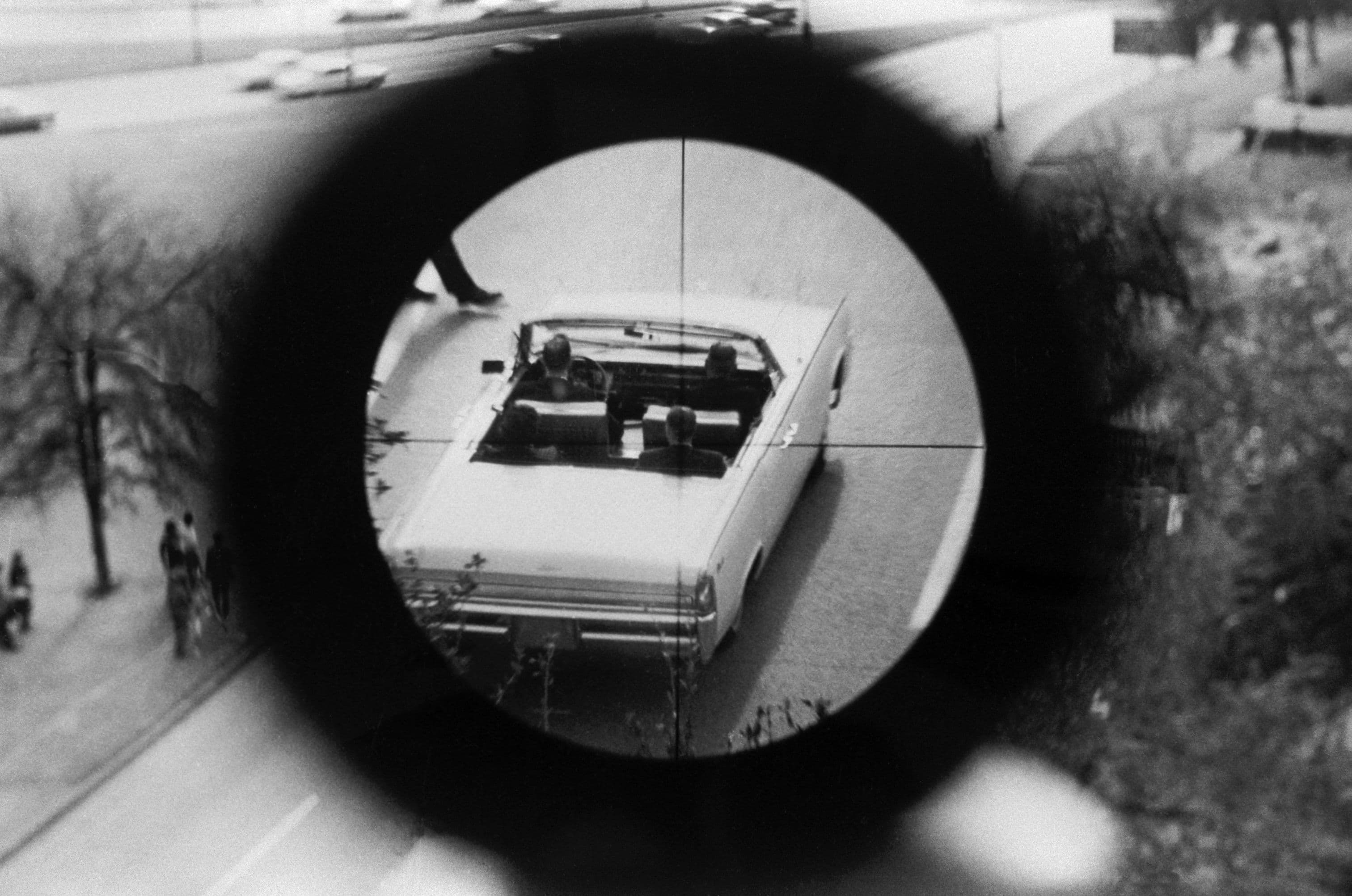
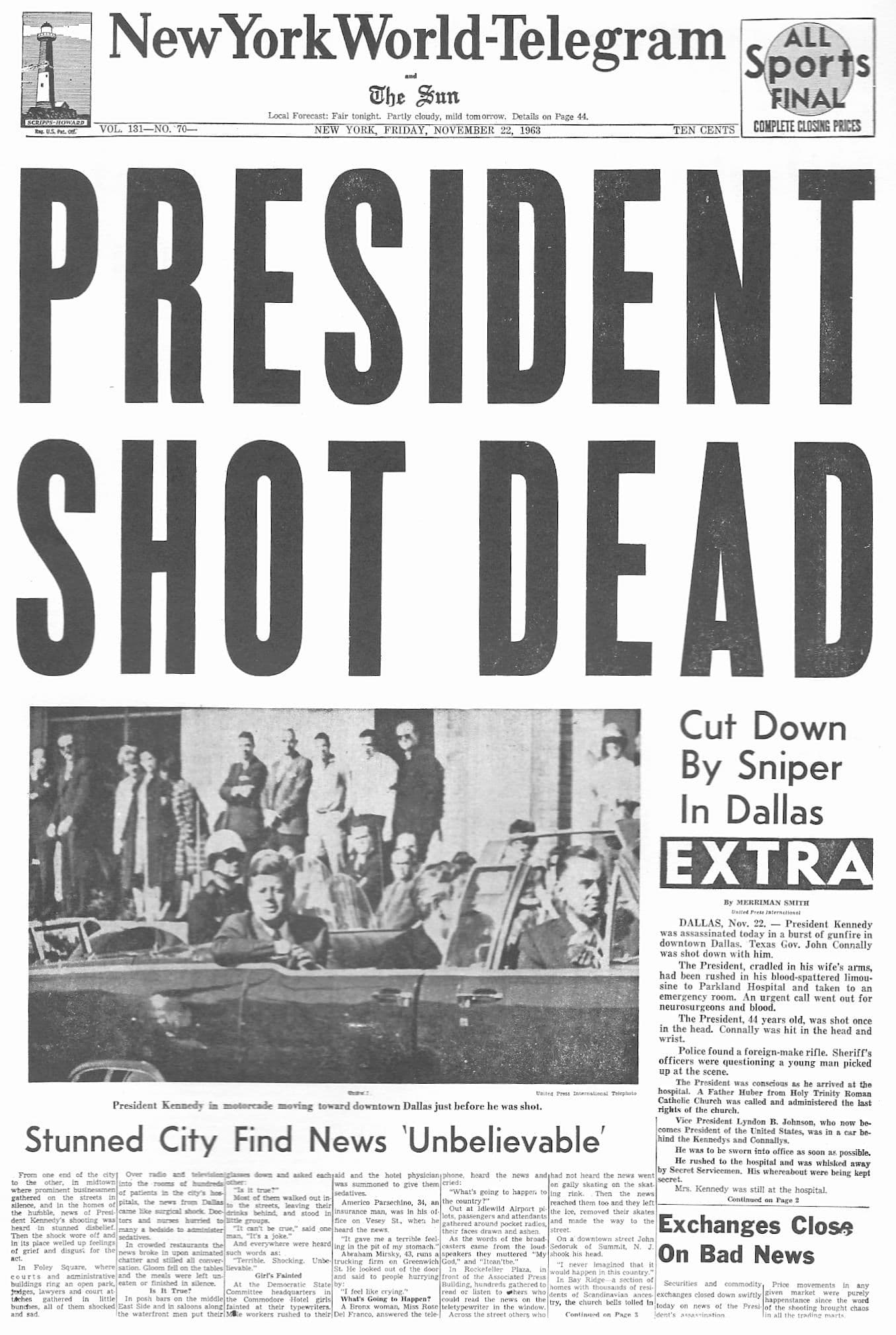
On 22 November 1963, Kennedy travelled through the city in an open limousine.
At 12.30 pm, shots rang out in Dealey Plaza.
Within hours, the President was dead.
A suspect was in custody.
Two days later, that suspect was dead too.
And one of the greatest conspiracy debates in modern history had begun.
Dealey Plaza
Kennedy was travelling through Dallas with First Lady Jacqueline Kennedy, Texas Governor John Connally and Connally's wife Nellie.
The presidential limousine entered Dealey Plaza and passed the Texas School Book Depository.
Shots were fired.
Kennedy was struck.
Governor Connally was also seriously wounded.
The limousine accelerated towards Parkland Memorial Hospital.
Doctors attempted to save the President, but Kennedy was pronounced dead.
The Warren Commission later concluded that Kennedy was hit by two bullets fired from above and behind him. One passed through his upper back and exited through his neck. The other struck the rear of his head and caused the fatal wound.
That is the basic medical finding around which much of the later debate developed.
The Texas School Book Depository
Attention quickly focused on a building overlooking the motorcade route.
The Texas School Book Depository.
Evidence was discovered on its sixth floor, including spent cartridge cases.
Investigators identified an employee named Lee Harvey Oswald as a suspect.
The Warren Commission ultimately concluded that the shots that killed Kennedy and wounded Connally had been fired from the sixth-floor window of the Depository.
Oswald had an unusual background.
He was a former US Marine.
He had defected to the Soviet Union in 1959.
He later returned to the United States.
He had publicly supported the Fair Play for Cuba Committee.
And shortly before Kennedy's assassination he had travelled to Mexico City, where he contacted Soviet and Cuban diplomatic offices.
These connections would later become central to conspiracy theories.
The Rifle
Investigators recovered a rifle from the Depository.
The weapon was a 6.5mm Mannlicher-Carcano.
The Warren Commission concluded that it belonged to Oswald and that physical and documentary evidence connected him to it.
The Commission's central conclusion was straightforward.
Lee Harvey Oswald fired the shots.
It also concluded that it had found no credible evidence that anyone had assisted him in planning or carrying out the assassination.
That became the official lone-gunman explanation.
But it did not settle the matter.
The Single-Bullet Theory
One of the most debated parts of the Warren Commission's case concerns the bullet that struck both Kennedy and Governor Connally.
According to the Commission, one bullet entered Kennedy's upper back, exited through the front of his neck and then struck Connally, causing several wounds.
Critics would later give it a much more memorable name.
The magic bullet.
That phrase makes the theory sound inherently impossible.
But later forensic examination by the House Select Committee on Assassinations found that the medical and trajectory evidence was consistent with a single bullet passing through Kennedy and then striking Connally.
That does not mean every disagreement about the trajectory vanished.
It means the single-bullet theory is not simply an absurd invention created to make the official story work.
There is forensic evidence supporting its physical possibility.
The Grassy Knoll
Almost immediately, some witnesses believed shots had come from somewhere other than the Depository.
Attention focused on the grassy knoll overlooking Dealey Plaza.
Witness recollections varied.
Some heard shots from behind Kennedy.
Others believed they came from the front or from more than one direction.
The possibility of another gunman became one of the foundations of the JFK conspiracy.
For decades, this was largely a matter of disputed witness evidence.
Then Congress reopened the investigation.
And something remarkable happened.
A Second Gunman?
In 1976, the US House of Representatives created the House Select Committee on Assassinations, known as the HSCA.
Its investigation reconsidered Kennedy's assassination using evidence unavailable or insufficiently examined by the Warren Commission.
In 1979, the Committee reached two conclusions that appear difficult to reconcile.
It agreed that Lee Harvey Oswald fired three shots, and that the second and third struck Kennedy, with the third killing him.
But it also concluded that acoustic evidence indicated a high probability that two gunmen fired at the President.
That led Congress to an extraordinary official conclusion:
President Kennedy was probably assassinated as the result of a conspiracy.
That isn't an internet theory.
It is contained in the official report of a United States congressional investigation.
But Who Was the Second Gunman?
The Committee couldn't say.
It stated explicitly that it was unable to identify the other gunman or determine the extent of any conspiracy.
And the finding was heavily dependent upon acoustic analysis of a Dallas police recording.
That evidence has itself been challenged by later researchers.
So even this remarkable congressional conclusion does not establish that a second shooter definitely existed.
What it does establish is that a later official investigation found enough uncertainty to reject the idea that the lone-gunman question had been completely settled.
The Warren Commission
President Lyndon Johnson created the Warren Commission one week after the assassination.
Its task was to establish what had happened and whether anyone else had been involved.
After nine months of investigation, the Commission concluded that Oswald acted alone.
It found no evidence that he had been part of a domestic or foreign conspiracy.
For many Americans, that became the official history.
But the later congressional investigation was critical of how thoroughly the conspiracy question had originally been investigated.
The HSCA concluded that the Warren Commission had conducted a professional and good-faith investigation into Oswald's responsibility for the shooting, but had failed adequately to investigate the possibility of conspiracy.
That distinction is important.
Congress did not conclude that the Warren Commission had deliberately lied.
It concluded that important areas had not been investigated sufficiently.
The CIA and FBI
The HSCA also found failures within the federal agencies that supplied information to the Warren Commission.
It concluded that the FBI's investigation into whether a wider conspiracy existed was seriously flawed in important areas.
It also found that the CIA had been deficient in collecting and sharing relevant information before and after the assassination.
Again, that does not prove the CIA or FBI killed Kennedy.
In fact, the Committee specifically concluded that neither organisation was involved in the assassination.
But those institutional failures created fertile ground for suspicion.
If agencies had withheld or failed to provide information, what else hadn't the public been told?
Jack Ruby
Then came perhaps the strangest development of all.
Lee Harvey Oswald never stood trial.
On 24 November, only two days after Kennedy was killed, police were transferring Oswald through the basement of Dallas Police Headquarters.
Television cameras were present.
So was nightclub owner Jack Ruby.
Ruby stepped forward and shot Oswald at close range.
Oswald later died.
The man accused of assassinating the President had been killed before he could be tried, cross-examined or publicly explain his actions.
The Warren Commission ultimately found no evidence that Ruby and Oswald were part of a conspiracy.
But the later HSCA was less comfortable with the original handling of the relationship between the two men.
It concluded that the Warren Commission had been incorrect in saying there were no significant associations involving Oswald and Ruby, although it did not establish that those associations proved a conspiracy.
Ruby's actions ensured that many questions would never be tested in court.
Organised Crime
Another major theory involves the Mafia.
Robert Kennedy had pursued organised crime aggressively as Attorney General.
Powerful crime figures had motive to despise the Kennedy administration.
The HSCA investigated the possibility extensively.
Its conclusion was cautious.
It found no evidence that the national organised-crime syndicate as a whole had participated in the assassination.
However, it stated that the possibility of involvement by individual organised-crime figures could not be ruled out.
That is very different from saying:
The Mafia killed JFK.
The evidence does not establish that.
But the congressional investigation also did not completely close the door.
Cuba
Cuba provides another obvious motive.
Kennedy's administration had supported efforts to remove Fidel Castro.
The CIA had been involved in covert operations targeting the Cuban regime.
Oswald had publicly supported Castro's Cuba.
This created conspiracy theories pointing in opposite directions.
Perhaps Castro had retaliated.
Perhaps anti-Castro Cubans blamed Kennedy for failing to overthrow Castro.
Perhaps intelligence personnel connected to covert Cuban operations were involved.
The HSCA investigated all of these possibilities.
It concluded that the Cuban government was not involved.
It also concluded that anti-Castro Cuban groups as organisations were not involved, although the possibility that individual members participated could not be completely excluded.
The Soviet Union
Oswald's years in the Soviet Union inevitably created suspicion.
Had he been recruited?
Was Moscow behind Kennedy's assassination?
The HSCA concluded that the Soviet government was not involved.
That doesn't make Oswald's Soviet connections irrelevant.
They remain an extraordinary element of his biography.
But there is no established evidence that the Kremlin ordered Kennedy's assassination.
The Autopsy
Kennedy's body was flown from Dallas to Washington, where an autopsy was conducted at Bethesda Naval Hospital.
The Warren Commission relied on the autopsy doctors and the physicians who had treated Kennedy at Parkland Memorial Hospital.
Later forensic review concluded that the two bullets that struck Kennedy came from behind and that the fatal head shot travelled downward when it entered the President's skull.
This evidence is important because one of the most persistent claims suggests Kennedy's fatal head wound proves he was shot from the front.
The official forensic panels did not reach that conclusion.
Their findings supported shots coming from behind.
Then Why Is the Autopsy So Controversial?
Because the handling and interpretation of the medical evidence became heavily disputed.
Doctors in Dallas were focused on trying to save Kennedy's life, not conducting a forensic investigation.
The autopsy took place later in a military hospital.
Photographs and X-rays existed, but the Warren Commission itself did not directly make full use of them when reaching its conclusions.
The later HSCA forensic panel examined the medical evidence in greater detail and still found that Kennedy was struck by bullets from behind.
So there are legitimate criticisms of how the original medical evidence was handled.
But that is not the same as proof that the body or wounds were secretly altered.
The Zapruder Film
One of the most remarkable pieces of evidence was captured accidentally.
Abraham Zapruder was filming Kennedy's motorcade on an 8mm home-movie camera when the President was shot.
His film captured the assassination.
Frame by frame, it shows Kennedy reacting to the shooting and then suffering the catastrophic head wound.
The film has been analysed endlessly.
To some viewers, Kennedy's violent movement after the head shot appears to suggest a bullet from the front.
To others, body movement after a gunshot cannot reliably establish bullet direction.
Official forensic analysis ultimately concluded that the fatal bullet entered from behind.
The Zapruder film therefore became something unusual.
The most famous visual evidence in the case also became one of its greatest sources of disagreement.
Was There a Cover-Up?
That depends what is meant by cover-up.
There is no proven evidence that the United States government secretly organised Kennedy's assassination and then concealed it.
But there is official evidence that agencies failed to provide the Warren Commission with all the information it should have received.
The HSCA concluded that the CIA and FBI were deficient in their handling and sharing of information and that the investigation into possible conspiracy was inadequate.
That distinction matters enormously.
Government failure and secrecy are documented.
Government responsibility for the assassination is not.
Conspiracy theories frequently collapse those two very different statements into one.
Could Kennedy Have Survived?
For the Utopia Files, there is another question.
Not simply:
Who killed JFK?
But:
Could the assassination itself have been staged?
Historically, the evidence presents an enormous obstacle.
Kennedy was shot in front of hundreds of witnesses.
The attack was filmed.
Doctors at Parkland treated catastrophic wounds.
His body was transported aboard Air Force One.
An autopsy was performed.
Jacqueline Kennedy accompanied her husband's body.
Kennedy's coffin lay in state in Washington.
Hundreds of thousands of people participated in the national mourning.
There is no credible historical evidence that Kennedy survived Dallas.
Any survival theory therefore requires something far more elaborate than a disputed gunman.
It requires a substitution.
And if a substitution occurred, it would have had to happen under extraordinary scrutiny.
The Strongest Evidence Against a Survival Conspiracy
Kennedy was visibly struck by gunfire.
The attack was captured on film.
Multiple witnesses saw the shooting.
Doctors treated him at Parkland.
He suffered catastrophic head injuries.
He was pronounced dead.
His body travelled back to Washington aboard Air Force One.
An autopsy was conducted.
His family accompanied the body.
He lay in state.
He was buried at Arlington National Cemetery.
There is no credible evidence that John F. Kennedy survived the assassination.
That should remain completely clear.
The genuine historical conspiracy concerns who participated in killing him, not whether he died.
But the Conspiracy Itself Is Real History
This is what makes Kennedy's case different from many celebrity conspiracy stories.
There really were two major official investigations.
And they did not completely agree.
The Warren Commission concluded that Oswald acted alone.
Fifteen years later, the House Select Committee on Assassinations concluded that Kennedy was probably assassinated as the result of a conspiracy, while also stating that it could not identify the second gunman or determine the scope of that conspiracy.
That disagreement exists in the official historical record.
You don't have to invent it.
The Questions That Remain
Why did Lee Harvey Oswald kill Kennedy?
Did he genuinely act alone?
If he did, why was he murdered before he could stand trial?
Why did Jack Ruby take such an extraordinary risk to kill him inside a police building?
Were all the shots really fired from the Texas School Book Depository?
Why did some witnesses believe they heard gunfire from another direction?
Was the acoustic evidence interpreted correctly?
If a second gunman existed, who was he?
Why did the FBI fail to investigate some conspiracy leads adequately?
Why did the CIA fail to share all relevant information with the Warren Commission?
Were those failures simply bureaucracy, secrecy and institutional self-protection?
Or did they conceal something more?
Did individual organised-crime figures have a role?
Did individual anti-Castro operatives have a role?
Was Oswald the architect of the assassination?
A participant?
Or something else entirely?
And perhaps the biggest question:
How can one official investigation conclude that Oswald acted alone, while another official investigation concludes that the President was probably killed as the result of a conspiracy?
More than sixty years later, that contradiction remains part of the official record.